
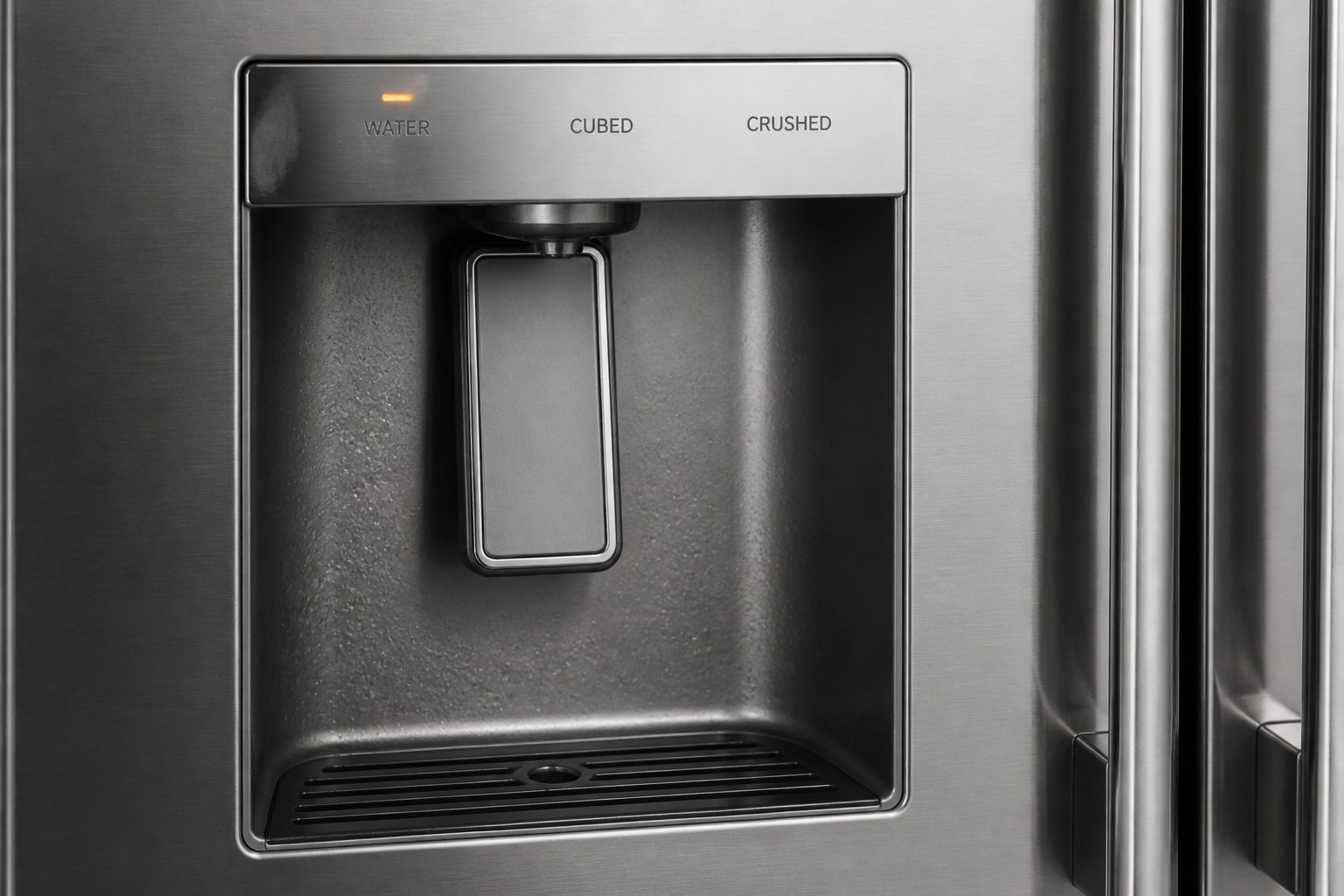
The drawing says polycarbonate overlay, per artwork. That is the whole material callout. It comes back from three suppliers as three different parts, all of them technically correct, and the one you pick is going to behave differently on the machine than the other two would have.
Polycarbonate is not a specification. It is a family, and the decisions that actually determine whether the overlay survives the panel it is bonded to sit above and below the base material rather than in it. Most drawings name the film and leave every one of those decisions to the supplier's default.
Here is what belongs on the drawing instead.
Hard coat is the line most drawings leave off
Start here, because it is the omission with the largest consequences.
Bare polycarbonate is comparatively soft and it does not love solvents. That is the honest position, and it is at odds with how the material gets talked about. Polycarbonate's reputation comes from impact resistance, which is real and considerable. Chemical and abrasion resistance is not where it wins, and a bare polycarbonate overlay on a panel that gets wiped down with an alcohol or a degreaser several times a shift will haze, then craze, then look terrible while still functioning perfectly.
The hard coat fixes that. It is a separate cured layer applied to the face of the film, and it is what carries the abrasion and chemical performance people assume the polycarbonate is providing. Specify it, or specify that you do not need it, but do not leave it to be inferred. A hard coated and an uncoated overlay can look identical in a first article and diverge completely by month eight.
If the panel lives somewhere genuinely aggressive, that is also the moment to ask whether polycarbonate is the right family at all. The material trade-offs across an industrial graphics job are stable and we laid them out when writing about how to specify equipment identification. The short version for this decision: polycarbonate buys you impact tolerance and formability, and polyester generally holds up better against sustained chemical attack. Picking polycarbonate because a panel needs embossed keys and then discovering it also faces a caustic wash-down is a common and expensive sequence.
Gauge decides whether the overlay can move
Thickness on an overlay is not about durability the way it is on a nameplate. It is about flex.
A thin film conforms. It bends over a curved housing, and more importantly it flexes at a key location without fighting the mechanism underneath. On anything sitting over a membrane switch, the overlay is part of the actuation, and a film that is too stiff makes the button feel dead no matter how good the switch is. Operators describe that as the panel feeling cheap, and they are describing the overlay gauge.
A thicker film is rigid and self supporting, holds an embossed shape far better, and resists being pushed through by a fingernail or a tool. On a flat legend panel with no moving parts, thicker is usually the better part.
Those pull against each other on the panels that have both, which is most of them. A panel with tactile keys in one region and static instructional graphics in another is asking the same piece of film to do two jobs. The resolution is usually to choose gauge for the keys, because a stiff key is a functional complaint and a slightly flexible legend area is not, and then use embossing rather than thickness to give the key region its structure.
Finish is an operator decision, not an aesthetic one
Finish gets picked in a design review under office lighting, and it gets lived with in a plant under a skylight or a bank of high bays. Those are not the same test.
The rule that catches people is that finish and display windows fight each other. A velvet or heavily textured face across an LCD or a seven segment display makes the display harder to read, and on a small character height it can make it genuinely difficult. If the panel has a window, the answer is selective finish: texture the keypad and touch area, leave the window region clear and untextured. That is a normal thing to ask for and it needs to be on the drawing, because a supplier quoting a single face finish across the whole part will quote the cheaper thing and be right to.
Backlit and dead front legends have the same relationship with finish. Anything that diffuses light on the face changes how a backlit legend reads when it comes on. Decide the finish and the lighting together, once.
Windows carry a second problem that finish does not solve. The clear region over a display is the one area of the panel where any scratch is directly in the operator's line of sight, and it is also the area most likely to get wiped with whatever cloth is nearest. On a textured keypad a light scuff vanishes. On a clear window it becomes the thing everyone looks at. That is the strongest argument for hard coating a panel that would otherwise not need it, and it is worth weighing even when the rest of the interface sees almost no contact.
A worked case makes the trade-off concrete. Take a control panel on a packaging machine: four tactile keys, a small character display, wiped down with a sanitizing solution twice a shift, mounted where an operator leans against it. Gauge gets chosen for the keys, so it is on the thin side. That thin film over an embossed key needs the emboss to provide the structure the gauge does not. The face wants a matte or fine texture across the keypad for glare and fingerprints, and a clear untextured window over the display. And because the sanitizer hits it twice a shift, the hard coat is not optional anywhere on the part. Four decisions, none of them about printing, and every one of them changes the quote.
The six lines that make a polycarbonate overlay quotable
A drawing carrying these gets you comparable quotes and a part that behaves the way you pictured.
- Hard coat, stated explicitly. Present or absent, and the chemicals it has to face by name, including cleaners.
- Gauge, and what drove it. Whether the overlay flexes at a key, conforms to a curve, or sits flat and static.
- Face finish by region. One finish or a selective finish, with the window and key areas called out separately if they differ.
- Embossing. Type and location if any, and whether the raised feature sits over a switch or is decorative.
- Windows and clarity. Which openings are clear, which are tinted, and what sits behind each one.
- Panel surface and adhesive. Material and finish of the part it bonds to, since the bond is a relationship with that surface.
Print method rides along with several of these. Second surface printing puts the graphic on the back of the film so the face material is the only thing exposed, which is what makes a polycarbonate overlay hold up at all under daily contact. Screen printing handles that well and lays down the dense, opaque ink films that dead front legends need. It is worth stating on the drawing rather than assuming, because it constrains the rest of the construction.
What to send with the request:
- Vector artwork with a revision number, fonts outlined, and the cut path on its own layer
- A drawing that names the critical dimension, usually window to window or window to mounting hole
- The panel material and finish, and a sample panel if the surface is unusual
- Cleaning agents and frequency, temperature range, and whether operators wear gloves
- Any backlighting, with the light source and whether legends are dead front
Embossing deserves one more note, because it is where gauge, finish and tooling all meet. A raised key needs enough material to hold the form and a finish that survives being stretched into it, and the die that creates it has a life. Tooled embossing is repeatable when it is set up as a controlled process and drifts when it is not, which is one of the reasons the same drawing can produce a part that feels right in year one and mushy in year three.
Once the material questions are settled, the remaining risk moves from specification to consistency. Color that matches the units already in the field, windows that land in the same place on run four as on run one, and a receiving check that catches a marginal lot before assembly starts are a separate discipline, and we covered them in what actually makes control panel overlays repeatable. Specification failures show up in year two. Consistency failures show up next quarter.
Neither one is a printing problem. Both are decisions somebody either made deliberately or left to a default. If you are drawing a panel now, the hard coat line and the finish by region line are the two that take a minute to add and are nearly impossible to fix later, and on industrial equipment that stays in service for a decade they are the difference between an interface that ages well and one that looks tired long before the machine does.